Every F1 Betting Market Explained: From Race Winner to Group Bets
 Available in US
Table of Contents
- Outright Championship Markets
- Race Winner Betting
- Podium Finish and Points Finish Markets
- Fastest Lap and Pole Position Bets
- Head-to-Head Driver Matchups
- Constructor and Team-Based Markets
- Group Betting and Classified Finisher Markets
- Novelty and Special Markets
- How to Pick the Right Market for Your Edge
- Common Questions About F1 Betting Markets
I placed my first F1 bet in 2017 on a race winner market – and lost. It took me another dozen attempts before I realised that “race winner” is just one corridor in a building with many floors. Formula 1 betting offers more market variety than most punters ever explore, and the ones who stick only to picking the winner leave serious value on the table. See also: f1 betting guide for all our F1 wagering content.
F1 accounts for roughly 0.4% of the global sports betting handle, per F1’s own commercial partnerships team. That figure is strikingly small for a sport watched by 1.83 billion cumulative viewers across the 2025 season, according to Nielsen data. But it also means the market is less efficient than football or horse racing, because bookmakers devote fewer resources to pricing F1 accurately, and that inefficiency creates opportunities for anyone willing to learn the full range of available wagers.
This guide walks through every F1 betting market you will encounter at a UK-licensed bookmaker, from long-term championship outrights down to niche group bets and novelty specials. Each section covers the mechanics, the settlement rules, and the strategic angle that separates a punter from a gambler.
Outright Championship Markets
Before a single wheel turns in pre-season testing, bookmakers already have prices up for the Drivers’ Championship and the Constructors’ Championship. I have watched these markets open as early as November for the following season, and in those early weeks the pricing tends to be lazy, based on the previous year’s finishing order rather than any real analysis of car development or driver moves.
The World Drivers’ Championship market asks you to pick the driver who will accumulate the most points across the entire season. With 24 races on the 2026 calendar, this is a marathon bet. You are locking your money up for months, and the odds will shift dramatically after every race weekend. A driver priced at 8/1 before Round 1 can drift to 25/1 after two poor results, or tighten to 3/1 after a dominant opening stretch.
The World Constructors’ Championship works the same way, except it aggregates points from both drivers in a team. This market often attracts less attention, which means bookmakers price it with less precision. I have found more consistent edge in constructor outrights than driver outrights over the past five seasons, largely because the public fixates on individual names rather than team performance trajectories.
Settlement is straightforward: the official FIA classification at the end of the season determines the winner. If a driver or team is disqualified after the final race, most bookmakers settle based on the amended standings – but always check the specific rules, because some operators settle on the podium ceremony result.
The key strategic question with outrights is timing. Prices are longest before the season starts, when uncertainty is highest. But placing a bet in February means you are guessing about car performance without any real data. I prefer to wait until after the first three or four races, when early-season volatility has shaken out some of the pretenders, but before the market fully adjusts. The trade-off is shorter odds, but a higher probability of backing the right horse – or rather, the right car.
Race Winner Betting
Race winner is the market most people think of when they hear “F1 betting.” You pick which driver will cross the line first in a specific Grand Prix. Simple concept, difficult execution.
The problem with race winner markets in Formula 1 is dominance. In seasons where one team has a significant car advantage, the favourite can be priced as short as 1/5 or even 1/8. There is no value in backing a driver at those prices unless you genuinely believe they have a 90%+ probability of winning – though even the most dominant cars in F1 history have not won 90% of their races in a season.
Where race winner betting becomes interesting is at circuits that disrupt the established pecking order. Street circuits like Monaco and Singapore, high-altitude tracks like Mexico City, and wet-weather races all compress the field and produce longer-odds winners. My approach is to skip the race winner market entirely when the favourite is priced below 4/6, and only engage when the top of the market is more competitive, typically 6/4 or longer for the front-runner.
Settlement generally follows the official FIA classification. If a driver finishes first on track but is later disqualified for a technical infringement, most UK bookmakers void bets on that driver and pay out on the revised winner. This is one area where reading your bookmaker’s F1 rules carefully genuinely matters.
One tactical note: race winner odds shift significantly between qualifying on Saturday and the race on Sunday. A driver who qualifies on pole at a track where overtaking is difficult – Monaco being the extreme example – will see their price shorten overnight. If you have done your homework and believe a driver will qualify well, placing your race winner bet before qualifying can capture better value than waiting until Sunday morning.
Podium Finish and Points Finish Markets
Three years into my F1 betting career, I had a realisation that changed everything: you do not need to pick the winner to make money. The podium finish market asks only that your driver finishes in the top three, and the points finish market extends that to the top ten. Both offer far more forgiving odds than the race winner market, and both reward a different kind of analysis.
Podium finish betting works well in F1 because the sport has a relatively predictable top tier. In most seasons, five or six drivers are genuine podium contenders at every race. The market prices this in, but it does not always price it correctly. A driver who qualifies fourth but has strong race pace – something you can assess from long-run data in Friday practice sessions – might be offered at 5/2 for a podium, when the real probability is closer to 50%. That gap is where profit lives.
Points finish markets are even more forgiving. With ten points-paying positions, you are essentially asking whether a driver will have a clean race and finish in the top half of the field. This is a strong market for midfield teams whose drivers consistently finish between sixth and tenth but rarely threaten the podium. The odds tend to be short – often around 1/3 to 1/2 – but they can form the backbone of accumulator strategies where you need reliable legs.
The distinction between podium and points finish matters for settlement too. If a driver is running third but retires on the final lap, they do not get a podium finish. Points are awarded based on the official classification, so a driver who completes at least 90% of the race distance might still be classified and score points even if they do not cross the finish line. Most casual bettors overlook this.
I use podium finish as my primary race-day market. It balances probability and payout better than race winner, and the analytical framework required – assessing qualifying pace, race pace, and strategic flexibility – maps directly onto the data available from practice sessions.
Fastest Lap and Pole Position Bets
Fastest lap and pole position sit in an odd corner of F1 betting: they are genuinely skill-based outcomes, but also heavily influenced by strategy and circumstance in ways that make them tricky to price.
Pole position betting is the more straightforward of the two. You are picking which driver will top qualifying, which in the current format means the fastest single lap in Q3. This market rewards deep knowledge of qualifying trim performance. Some drivers and teams consistently extract more from their car over a single lap than they do in race conditions. The data from practice sessions, particularly the short-run pace in FP2 and FP3, gives you a reasonable read on qualifying potential.
The catch with pole position is that weather disrupts everything. A sudden rain shower in Q3 can hand pole to a driver who gambled on intermediate tyres at the right moment, regardless of outright pace. If you are betting on pole position, check the weather forecast for the qualifying hour specifically, not just the race day outlook.
Fastest lap is stranger. Since the FIA introduced the bonus point for fastest lap in 2019, teams have started pitting their lead driver for fresh soft tyres on the final lap specifically to grab it. This means the fastest lap often goes to whoever has a comfortable enough lead to afford an extra pit stop without losing position. It is less about outright car speed and more about race circumstances, specifically who is running in clean air with a big gap behind them in the closing laps.
I rarely bet on fastest lap as a standalone market. The outcome is too dependent on late-race strategy decisions that are impossible to predict pre-race. But fastest lap selections work well as components in bet builder products, where you can combine them with other outcomes for the same race at a combined price.
Head-to-Head Driver Matchups
Head-to-head driver matchups are, in my view, the single most underrated market in F1 betting. The bookmaker pairs two drivers and you simply pick which one finishes ahead. No need to predict the winner, no need to guess the podium. You simply decide whether Driver A beats Driver B.
This market strips away most of the chaos that makes F1 hard to bet on. Safety cars, rain, first-lap incidents. They affect both drivers in a head-to-head roughly equally, especially when the pairing involves teammates in the same car. The signal-to-noise ratio is much higher than in outright winner markets.
Teammate head-to-heads are the bread and butter here. Two drivers in identical machinery, so the variable you are analysing is driver skill, form, and strategic bias from the team. Over a season, one teammate almost always dominates the other in race finishes. If you can identify which driver has the edge early in the season, teammate head-to-heads become a reliable source of small, consistent profits.
Cross-team head-to-heads are more volatile but can offer better odds. These pair drivers from different constructors: a midfield driver against a rival from another midfield team. Here, car performance becomes the primary variable, and you need to assess which team’s car suits a particular circuit. A team with a strong low-downforce package will have an advantage at power circuits like Monza, while a car with excellent mechanical grip will shine at slow-speed street circuits.
Settlement in head-to-head markets typically requires both drivers to start the race. If one driver does not start (grid penalty, mechanical failure on the formation lap, or a late withdrawal) the bet is usually voided. If both start but one retires, the driver who completes more laps (or is classified higher) wins the head-to-head. Always verify these rules with your specific bookmaker, because there are minor variations.
I allocate roughly 30% of my F1 betting activity to head-to-head markets. They are the closest thing F1 offers to a “pure skill” bet, and over a 24-race season, the edge compounds.
Constructor and Team-Based Markets
Constructor markets ask you to bet on teams rather than individual drivers. The most common form is the constructors’ championship outright, covered earlier, but several bookmakers also offer race-specific constructor bets: which team will score the most points in a given Grand Prix, or which constructor will have a car on the podium.
The advantage of constructor betting is that it hedges against individual driver errors. If you believe McLaren has the fastest car at a particular circuit but are not sure whether Norris or Piastri will come out on top, a “McLaren podium” or “McLaren highest-scoring constructor” bet lets you back the team without choosing between drivers. One of them just needs to deliver.
Constructor-versus-constructor head-to-heads also exist, mirroring the driver head-to-head format. These can be particularly useful in the congested midfield, where four or five teams are separated by tenths of a second. Picking which of two closely matched teams will outscore the other on a given Sunday often comes down to tyre strategy and pit stop execution – factors you can assess from practice data.
One structural consideration: constructor bets aggregate both drivers’ results, which means a single retirement from one driver can swing the outcome dramatically. A team might dominate a race with one car but score zero with the other due to a mechanical failure. This volatility makes constructor markets less predictable on a race-by-race basis than driver markets, but more predictable over a season where the law of averages smooths things out.
Group Betting and Classified Finisher Markets
Group betting is where F1 markets start to resemble horse racing, and it is a format that most casual F1 bettors have never encountered. The bookmaker divides the grid into groups – typically three or four drivers of similar ability – and you pick which driver from that group will finish highest in the race.
The groupings are what make this market interesting. A typical group might contain four midfield drivers from different teams: one from Aston Martin, one from Alpine, one from Haas, one from Williams. Because these drivers are broadly comparable in machinery, the bet becomes about driver skill, team strategy, and circuit suitability. The odds tend to be more balanced than in outright markets, often ranging from 2/1 to 7/2 for each driver in a four-driver group.
Over the past two seasons, F1 has shown a 0.95 correlation between market-implied probabilities and actual bookmaker coefficients, per Sparkco’s analysis of championship prediction markets. That efficiency holds for the major markets – race winner, championship outrights – but group betting is a smaller, less liquid market where the pricing is often softer. I have found consistent value by cross-referencing group betting odds with practice session data, particularly when one driver in a group has shown unusually strong pace on Friday but the odds have not adjusted.
Classified finisher markets are related but distinct. Under FIA rules, a driver is classified as a finisher if they complete at least 90% of the winner’s race distance. This means a driver whose car breaks down on lap 55 of a 57-lap race can still be classified, still score points, and still count as a “finisher” for betting purposes. Some bookmakers offer over/under markets on the number of classified finishers, which can be a smart play at circuits historically known for high attrition rates – Singapore, Jeddah, and Monaco all tend to produce more retirements than average.
The classified finisher rule also matters for other markets. If you have backed a driver to finish in the points and they retire near the end, check whether they completed 90% of the distance. You might still win a bet you thought was lost.
Novelty and Special Markets
Beyond the core markets, most major UK bookmakers offer a rotating selection of specials and novelty bets. These range from the reasonably analytical – “will there be a safety car?” or “how many drivers will retire?” – to the purely entertaining, like betting on whether a specific driver will set a new lap record.
The safety car market deserves a mention because it is one of the few binary bets in F1 where historical data provides a genuine edge. Safety car deployment rates vary significantly by circuit. Street circuits like Monaco and Baku have historically produced safety car periods in over 60% of races, while wide-open permanent circuits like Paul Ricard and Barcelona see them far less frequently. A “yes” bet on safety car deployment at a street circuit is often underpriced.
The real frontier in F1 specials is data-driven micro-markets. ALT Sports Data, appointed as F1’s official betting data supplier in February 2025, is developing real-time predictive analytics that will power entirely new in-play wagers. Jonny Haworth, F1’s Director of Commercial Partnerships, has described models that predict which driver will pit next or who will win a specific on-track battle over the next ten laps. These markets do not exist yet at most bookmakers, but they are coming – and when they arrive, the punters who understand F1 telemetry and strategy will have a significant first-mover advantage.
For now, I treat novelty markets as a small allocation – no more than 5-10% of my race weekend activity. They are fun, they keep you engaged during the race, and occasionally they offer genuine value when the bookmaker has not done their homework on circuit-specific statistics. But they are not where serious, repeatable edge lives.
How to Pick the Right Market for Your Edge
Nine years of F1 betting have taught me one principle above all others: match the market to your information advantage. If your edge comes from understanding qualifying pace, bet on pole position or race winner. If you are better at reading tyre degradation data, focus on podium finish and head-to-heads where race pace matters more than grid position. If you track team strategy patterns, constructor bets and group betting reward that knowledge.
Betting turnover on F1 driver futures reached an estimated $45 million in 2024, up from $36 million the previous year, according to Sparkco’s championship prediction markets report. That growth is concentrated in the major markets – championship outrights and race winners. The smaller markets, from head-to-heads to group bets, see less volume, which means the odds are set with less rigour and adjusted less frequently. For a punter willing to do the work, that is where the edge sits.
My recommendation for anyone starting out: begin with head-to-head markets. They are the easiest to analyse, the least affected by random chaos, and the most forgiving of early mistakes. Once you have a season of head-to-head betting under your belt and a feel for how the data translates to results, expand into podium finish and group betting. Leave race winner and championship outrights until you have developed a genuine pricing model – understanding each-way mechanics will also help you extract more from longer-odds selections.
The worst approach is to bet on every market in every race. F1 has 24 Grands Prix, many with sprint races attached, and each weekend offers dozens of individual markets. Betting on all of them is a fast route to an empty bankroll and no clear sense of where your profits or losses are actually coming from. Pick two or three markets, specialise, track your results, and adjust. The data will tell you where your edge lives. See also: find the best F1 betting sites in the UK to place your bets.
Common Questions About F1 Betting Markets
What is group betting in Formula 1?
Group betting divides the grid into clusters of three or four drivers with similar ability, and you pick which driver in the group will finish highest. The odds are typically more balanced than in outright markets because the drivers are closely matched. It is a lower-profile market, which means bookmaker pricing is often less precise – creating value for punters who track practice session data and circuit-specific form.
How does the FIA 90% classification rule affect bet settlement?
Under FIA rules, a driver who completes at least 90% of the winner’s race distance is classified as a finisher, even if they retired before the chequered flag. This means a driver who drops out near the end of a race might still be classified in the results, still score points, and still settle bets on points finish or classification markets as a winner. Always check your bookmaker’s settlement rules, but most UK operators follow the official FIA classification.
Can you combine multiple F1 markets in one bet?
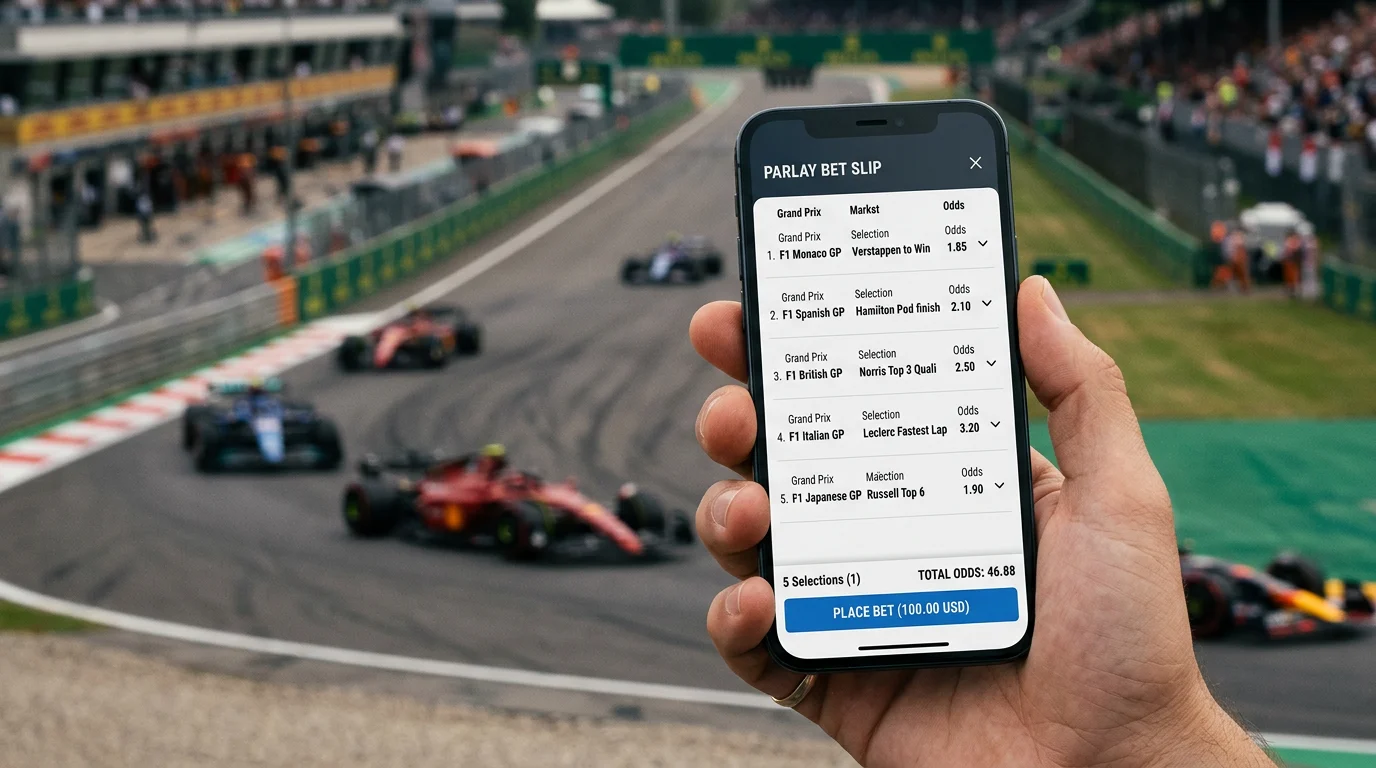
Yes. Most UK bookmakers offer accumulator betting across F1 markets, and many now provide bet builder tools that let you combine selections from the same race – for example, a race winner pick with a fastest lap selection and an over/under on classified finishers. Be cautious with correlated selections, though: combining a race winner pick with a podium finish pick for the same driver does not genuinely increase your potential edge, because one outcome is a subset of the other.
Which F1 market has the best value for beginners?
Head-to-head driver matchups. They strip out much of the chaos that makes F1 unpredictable – safety cars, first-lap incidents, and weather all affect both drivers in a pairing roughly equally. The analysis required is more focused, the outcomes are binary, and over a season the results tend to be more consistent than outright winner or podium markets. Start with teammate head-to-heads, where the cars are identical and the variable is purely driver performance.
Created by the ”f1 Betting Guide” editorial team.