Best F1 Betting Sites in the UK: What to Look for in 2026
 Available in US
Table of Contents
- How We Evaluate F1 Betting Sites
- Why a UKGC Licence Is Non-Negotiable
- Comparing Market Depth for Formula 1
- Odds Competitiveness: Who Offers the Best F1 Prices?
- In-Play Features and Streaming
- App Quality and Mobile Experience
- Promotions and Enhanced Odds: Cutting Through the Noise
- The Betway-F1 Partnership: What It Means for Punters
- Common Questions About F1 Betting Sites
In March 2026, Betway became the first Official Betting Operator in Formula 1 history, covering Europe, the Middle East, Africa, Canada, and Mexico. A month later, FanDuel secured the equivalent title for the United States and Canada. These are not cosmetic sponsorship deals. They signal that F1 has decided betting is a strategic priority, and the platforms that partner with the sport will shape how punters interact with it for years to come. See also: f1 betting guide for our full library of F1 resources.
For UK bettors, the question is not whether you can bet on F1 (every major licensed operator offers F1 markets) but which platform gives you the best combination of market depth, odds quality, live features and regulatory protection. I have used more than a dozen UK-licensed betting sites for F1 over the past nine years, and the differences are real. Some offer 30+ markets per Grand Prix; others list barely a dozen. Some reprice live odds every few seconds; others lag by minutes. These gaps directly affect your ability to find and exploit value.
This guide is not a ranking of “best sites.” I do not take affiliate commissions, and I am not here to sell you a sign-up bonus. Instead, I will walk through the criteria that actually matter for F1 betting – the criteria I wish someone had explained before I opened accounts at platforms that turned out to be useless for motorsport.
How We Evaluate F1 Betting Sites
Most “best betting sites” guides use criteria that are either vague or self-serving: “great bonus offers,” “excellent customer service,” “wide range of sports.” These tell you almost nothing about whether a platform is actually good for F1 betting specifically. I evaluate sites on six dimensions that directly affect the quality of the F1 betting experience.
First, UKGC licensing: this is binary, not a spectrum. Second, F1 market depth (how many distinct betting markets the platform offers per Grand Prix weekend). Third, odds competitiveness (whether the prices offered are consistently close to or better than the market average). Fourth, in-play capability (how quickly live odds update and whether markets are available throughout the race). Fifth, app quality (the mobile experience during a live race, where speed and stability are non-negotiable). Sixth, responsible gambling tools (deposit limits, time-outs, and self-exclusion options) that are accessible without needing to contact customer support.
Each of these criteria matters independently. A site with excellent odds but no in-play markets is useless for anyone who bets during races. A site with deep F1 markets but an unreliable app is a liability on race day. And a site without a UKGC licence is simply off the table. The Gambling Commission levied £13.4 million in fines and regulatory settlements against non-compliant operators in 2023-2024 alone. If an operator cannot maintain compliance with UK regulations, they are not a safe place for your money.
What I do not evaluate: welcome bonuses, VIP programmes, or promotional gimmicks. These change monthly, they are designed to attract new customers rather than reward experienced ones, and they rarely influence the long-term quality of the F1 betting experience. A site that offers a generous sign-up bonus but has shallow F1 markets and sluggish in-play odds is a worse choice than a site with no bonus but deep, well-priced motorsport coverage. Focus on the structural advantages, not the one-off incentives.
Why a UKGC Licence Is Non-Negotiable
I will keep this blunt: if a betting site does not hold a UK Gambling Commission licence, do not use it for F1 betting. Full stop. No exceptions for better odds, bigger bonuses, or more exotic markets.
The UK gambling industry generated a total Gross Gambling Yield of £16.8 billion in the year to March 2025, per the Gambling Commission’s annual report, a 7.3% increase year on year. The remote casino, betting, and bingo sector alone accounted for £7.8 billion of that, up 13.1%. This is a regulated industry of enormous scale, and the regulatory framework exists to protect you.
A UKGC licence guarantees several things. Your funds must be held in segregated accounts, meaning if the operator goes bankrupt, your deposits are ring-fenced from creditors. The operator must provide responsible gambling tools (deposit limits, cooling-off periods, self-exclusion via GamStop) and must not encourage problem gambling. Dispute resolution is available through an independent alternative dispute resolution provider. And the operator is subject to ongoing compliance monitoring, with real financial penalties for breaches.
Offshore operators licensed by jurisdictions like Curacao or Antigua may offer superficially better terms, but they operate outside UK consumer protection law. If something goes wrong (a disputed settlement, a withdrawn balance, a refusal to pay out) your recourse is effectively zero. The UKGC is not perfect, but it provides a baseline of consumer protection that no offshore regulator matches.
The regulatory environment is also tightening. From April 2025, the UKGC introduced maximum stake limits on online slots: £5 for all adults, £2 for those aged 18-24, as part of a broader push toward affordability checks and enhanced player protection. While these specific limits do not apply to sports betting directly, they signal the direction of regulation: more oversight, more safeguards, and higher compliance costs for operators. Operators who cut corners on compliance to save costs are the ones most likely to cause problems for their customers. A UKGC licence is your insurance policy against that risk.
Checking a licence takes thirty seconds. Visit the Gambling Commission’s public register, enter the operator’s name, and verify that their licence is active and covers the activities you are using – remote betting, specifically. Every legitimate UK betting site displays its licence number in the footer. If you cannot find it, that tells you everything you need to know.
Comparing Market Depth for Formula 1
Market depth is where F1 betting sites diverge most sharply. Some operators treat Formula 1 as a niche sport and offer only the basics: race winner, championship outrights, and maybe podium finish. Others recognise F1’s complexity and provide 30 or more markets per race: head-to-heads, group bets, fastest lap, pole position, classified finishers, safety car yes/no, constructor bets, and bet builder options.
The depth matters because your edge might live in a market that a shallow operator does not offer. If your analysis consistently identifies value in head-to-head matchups but your bookmaker only offers four pairings per race instead of the ten that a deeper competitor provides, you are leaving money on the table. The appointment of ALT Sports Data as F1’s official betting data supplier in February 2025 is likely to widen this gap further – operators who invest in integrating the new data feeds will offer richer in-play markets, while those who treat F1 as an afterthought will fall behind.
I check market depth at the start of each season by comparing the number of available markets for the opening Grand Prix across my four bookmaker accounts. The count varies more than you would expect – sometimes by a factor of two. A site offering 15 markets for the Australian Grand Prix while a competitor offers 35 is not just less convenient; it represents a fundamentally different level of commitment to the sport. And that commitment tends to correlate with better odds pricing, because the operator pricing 35 markets has a dedicated motorsport trading team rather than a generalist handling everything from darts to F1.
Odds Competitiveness: Who Offers the Best F1 Prices?
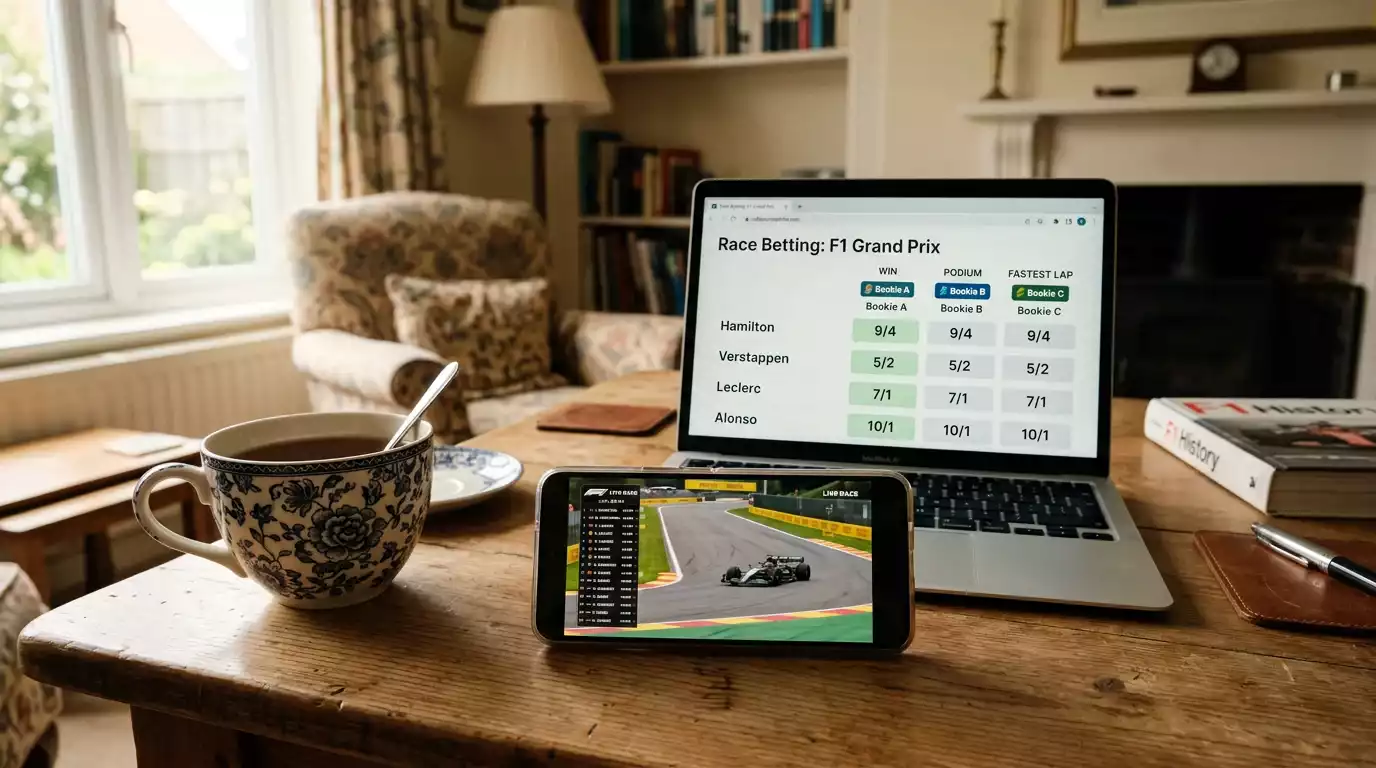
Two bookmakers, same race, same driver, same market – and one is offering 7/2 while the other has 4/1. That difference is not a rounding error. It is the difference between a £35 return and a £40 return on a £10 stake. Over a season of betting, consistently taking the worse price costs hundreds of pounds.
YouGov’s 2025 data on motorsport bettors shows that 41% used Bet365 in the preceding week – by far the most popular single platform. But popularity and price competitiveness are not the same thing. The most-used site is not always the best-priced site for any given selection. My approach is to maintain accounts with at least three operators and check prices before every bet. The process takes less than two minutes and is the single highest-return-on-effort activity in my entire betting workflow.
Odds competitiveness tends to be more variable in F1 than in football. Football markets are priced by large, well-resourced trading teams at every major bookmaker, and the prices converge quickly. F1 receives less attention, especially for the smaller markets like head-to-heads and group bets. This means price disparities persist longer and are sometimes larger. I have seen head-to-head odds differ by 30% between two major UK operators, with neither adjusting for hours.
The overround, the total margin built into the odds across all selections in a market, is another useful comparison tool. A site running a race winner market at 118% overround is offering structurally better value than one at 125%. Some operators consistently run lower overround on motorsport than others, and tracking this over a few race weekends reveals which sites deserve the bulk of your activity.
In-Play Features and Streaming
In-play features separate the serious F1 betting sites from the rest. The minimum requirement is live odds that update within a few seconds of on-track events. Beyond that, the features that matter are: the number of in-play markets available during the race, the speed at which markets reopen after suspensions (safety cars, red flags), and whether the platform offers a cash-out facility with partial cash-out options.
Jonny Haworth has indicated that F1 will launch a dedicated betting content stream on its web and app platforms, with editorial content focused on explaining new market types and how to engage with them on a weekly basis. This suggests that the in-play experience is about to become significantly richer across the sport’s official channels. Operators who integrate closely with these new data feeds and content streams will offer a better live betting experience than those who rely solely on their own trading models.
Live streaming through the betting app is a bonus but not essential for F1. Most UK viewers watch races on Sky Sports or Channel 4’s highlights coverage, so in-app streaming is redundant if you already have a television on. What matters more is the app’s ability to display real-time race data alongside the betting interface – positions, gaps, lap times, tyre compounds. Some operators integrate this data natively; others force you to switch between the betting app and a separate timing screen. The integrated experience is noticeably faster for placing time-sensitive in-play bets.
App Quality and Mobile Experience
Race day is the worst possible time for a buggy app. If the app crashes during a safety car period while you are trying to place an in-play bet, or if it takes eight seconds to load the F1 market page when you need the odds in real time, the app has failed at its primary job.
I test each bookmaker’s app during the first three race weekends of the season: load times, responsiveness during high-activity periods (first lap, pit windows, safety cars), and stability over a full two-hour race. The differences are stark. Some apps handle the load effortlessly; others slow to a crawl during peak moments, precisely when speed matters most. If an app performs poorly during the first three races, I deprioritise it for in-play betting for the rest of the season.
Push notifications for odds movements and market openings are another differentiator. An alert that a specific F1 market has been repriced – or that a new in-play market has opened mid-race – can prompt a bet you would otherwise have missed. Not all apps offer this level of granularity for motorsport; many default to football-centric notification schemes. Check whether you can configure F1-specific alerts before relying on the notification system.
The bet placement flow itself matters. How many taps does it take to navigate from the home screen to an F1 in-play market, enter a stake, and confirm the bet? In my experience, the best F1 betting apps require four taps or fewer. The worst require seven or eight, with mandatory pop-ups and confirmation screens that slow you down during volatile markets. Test this before race day, not during it.
Promotions and Enhanced Odds: Cutting Through the Noise
Free bets, enhanced odds, accumulator insurance, bet-and-get offers – the promotional landscape for F1 betting is noisy, and most of the noise is designed to benefit the operator, not you.
UK gambling companies spend roughly £1.5 billion per year on advertising, per BMJ research. A significant portion of that goes toward promotional offers that create the illusion of value while embedding restrictions – wagering requirements, minimum odds, maximum payouts, expiry periods – that recapture most of the “free” money. Enhanced odds that boost a driver from 3/1 to 6/1 look generous until you read the maximum stake of £5 and the requirement to wager your winnings three times before withdrawal.
That said, not all promotions are worthless. Sign-up offers where you genuinely receive a free bet with no wagering requirements attached – increasingly rare but still available – represent real value if you use them on a selection you would have backed anyway. The key is to never let a promotion drive your betting decision. If a free bet offer is available for the Austrian Grand Prix and you were already planning to bet on that race, take it. If the only reason you are betting is because a free bet exists, the promotion is costing you money, not saving it.
Enhanced odds around major Grands Prix – British GP, Monaco, Abu Dhabi – are common. Evaluate them by comparing the enhanced price against the standard market price across other operators. If the enhanced odds represent genuine value above the best available standard price, they are worth taking within the stake limits. If the enhanced odds merely match what another bookmaker is already offering at full stakes, the promotion is cosmetic.
The Betway-F1 Partnership: What It Means for Punters
The Betway-F1 deal, announced in March 2026, is the first time Formula 1 has appointed an official betting operator. Neal Menashe, CEO of Super Group (Betway’s parent company), described it as reinforcing a commitment to sport at the highest level while ensuring customers have access to innovative markets during race weekends. The partnership covers Europe, the Middle East, Africa, Canada, and Mexico – a substantial geographic footprint.
For UK punters, the practical implications are still emerging, but the direction is clear. Betway will receive privileged access to F1’s data infrastructure, branding integration during race broadcasts, and the ability to offer markets developed in collaboration with the sport itself. This is similar to the model that works in football, where official betting partners of the Premier League or Champions League gain data access and co-branding that translates into richer market offerings.
Does this mean you should use Betway for F1 betting? Not necessarily – and certainly not by default. The partnership gives Betway a structural advantage in terms of data access and market innovation, but whether that translates into better odds and a better user experience depends on execution. I will be evaluating Betway’s F1 offering against the same criteria applied to every other operator: market depth, odds competitiveness, in-play quality, and app performance. Official partner status is a reason to watch closely, not a reason to commit blindly.
The broader significance of the Betway and FanDuel partnerships is what they signal about F1’s strategic direction. The sport is actively building out its betting ecosystem – data suppliers, official operators, dedicated content streams – in a coordinated way that will reshape how punters engage with race weekends over the next several seasons. The platforms that secure official partnerships will likely offer first-mover advantages on new market types. The platforms that do not will need to compete on price and user experience. Either way, the F1 betting landscape in 2028 will look very different from today.
My advice: open an account with the official partner, but keep your existing accounts active. Use the official partner for their exclusive market offerings – those will likely appear first on their platform – while continuing to compare odds across your full roster of bookmakers. Loyalty to a single operator is the enemy of value. The official partnership is a data advantage for the operator, not a guarantee of better prices for you. See also: learn about F1 pit stop betting for a unique market angle.
Common Questions About F1 Betting Sites
Do all UK betting sites offer the same F1 markets?
No – and the differences are significant. Some operators offer 30 or more markets per Grand Prix, including head-to-heads, group bets, bet builder options, and safety car markets. Others list fewer than a dozen, covering only the basics like race winner and championship outrights. The depth of F1 market coverage varies widely and directly affects your ability to find value. Checking the market count for the first race of the season across your preferred operators reveals which ones take motorsport seriously.
What does the Betway-F1 official partnership change for bettors?
Betway gained privileged access to F1’s data infrastructure and co-branding during race broadcasts as the sport’s first Official Betting Operator. This could translate into richer, more innovative markets developed in collaboration with F1 and ALT Sports Data. However, an official partnership does not automatically mean better odds or a superior user experience – those still depend on execution. Evaluate Betway on the same criteria as any other operator: market depth, pricing, in-play features, and app quality.
How do I check whether a betting site has a valid UKGC licence?
Visit the Gambling Commission’s public register on their official website and search for the operator by name. The register shows whether the licence is active, what activities it covers, and whether any regulatory actions have been taken. Every legitimate UK betting site also displays its licence number in the footer of its website and app. If you cannot find a licence number, or if the register shows the licence as suspended or revoked, do not use that platform.
Created by the ”f1 Betting Guide” editorial team.