F1 Betting Exchanges: How Peer-to-Peer Markets Change the Game
 Available in US
Table of Contents
- Back and Lay Mechanics in F1 Markets
- Why Exchange Odds Beat the Bookmaker Margin
- Trading F1 Races In-Play on the Exchange
- Liquidity Patterns and When to Place Your Orders
- Exchange-Specific F1 Strategies That Work
- When Exchanges Fall Short for F1 Punters
- Choosing the Right Races for Exchange Betting
- Building an Exchange-First F1 Betting Workflow
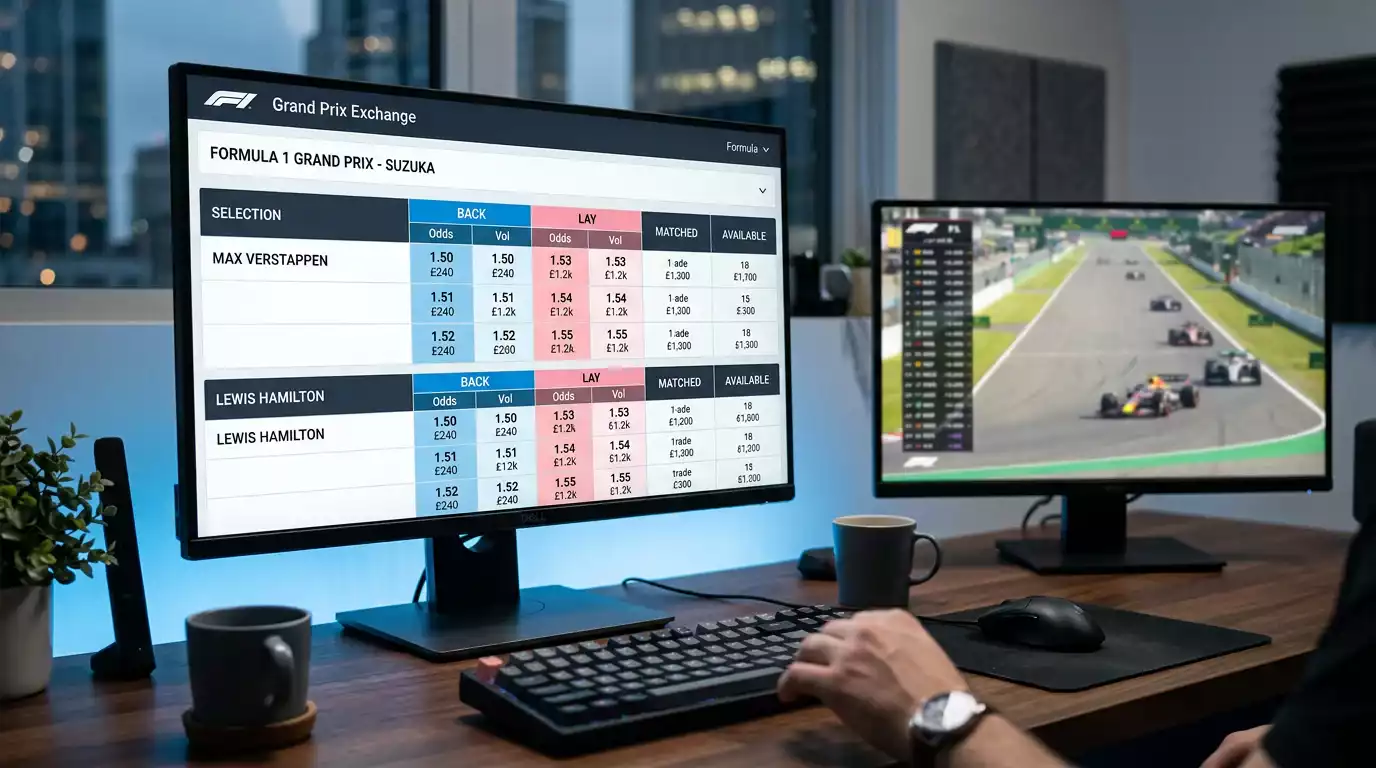
The first time I placed a lay bet on an F1 race, I felt like I had discovered a trapdoor in a building I had walked through for years. A driver was odds-on favourite after dominating practice, and I could bet against him at prices that barely existed in the traditional market. He retired on lap 14 with a gearbox failure, and I collected more from that single lay than from any matched accumulator I had built all season. That moment rewired how I think about F1 betting entirely. See also: f1 betting guide for exchange and bookmaker comparisons.
Exchanges strip out the middleman. Instead of placing a bet with a bookmaker who sets odds and takes a margin, you trade directly with other punters. One side backs a result to happen, the other lays it – betting it will not happen. The exchange takes a small commission on winning trades, and that is the entire business model. For F1 punters, this opens up angles that fixed-odds markets simply cannot replicate.
Back and Lay Mechanics in F1 Markets
I spent my first month on an exchange getting the terminology wrong and the maths right, which is exactly the wrong way round. The back side works identically to a traditional bet – you pick a driver, take a price, and win if he finishes where you predicted. The lay side is the mirror image. When you lay Max Verstappen at 2.50 in the race winner market, you are offering someone else that price and accepting liability if he wins. Your profit equals their stake if he does not.
The liability question trips up newcomers constantly. Laying at 2.50 with a backer’s stake of 10 pounds means your liability is 15 pounds – the potential payout minus the stake you collect. The higher the odds you lay, the larger your exposure grows per pound matched. Laying a 20/1 outsider sounds easy until you realise that a 10-pound match creates 190 pounds of liability sitting in your account until the race finishes.
F1 exchange markets typically cover race winner, podium finish, qualifying position, and head-to-head matchups. Liquidity concentrates heavily on race winner markets, where Betfair’s exchange alone processed roughly 200 million pounds in F1 turnover during 2023. The head-to-head markets carry thinner liquidity but often produce the widest pricing gaps between exchange and fixed-odds books, which is where patient punters build consistent returns.
Why Exchange Odds Beat the Bookmaker Margin
A colleague once described the traditional bookmaker margin as an invisible tax that most punters never notice because they never see the receipt. Exchange pricing makes the receipt visible. Where a fixed-odds book prices a 20-runner F1 market with an overround between 115% and 130%, exchange markets routinely sit at 101% to 103% – the gap between back and lay prices on the same runner. That difference compounds violently over a full season.
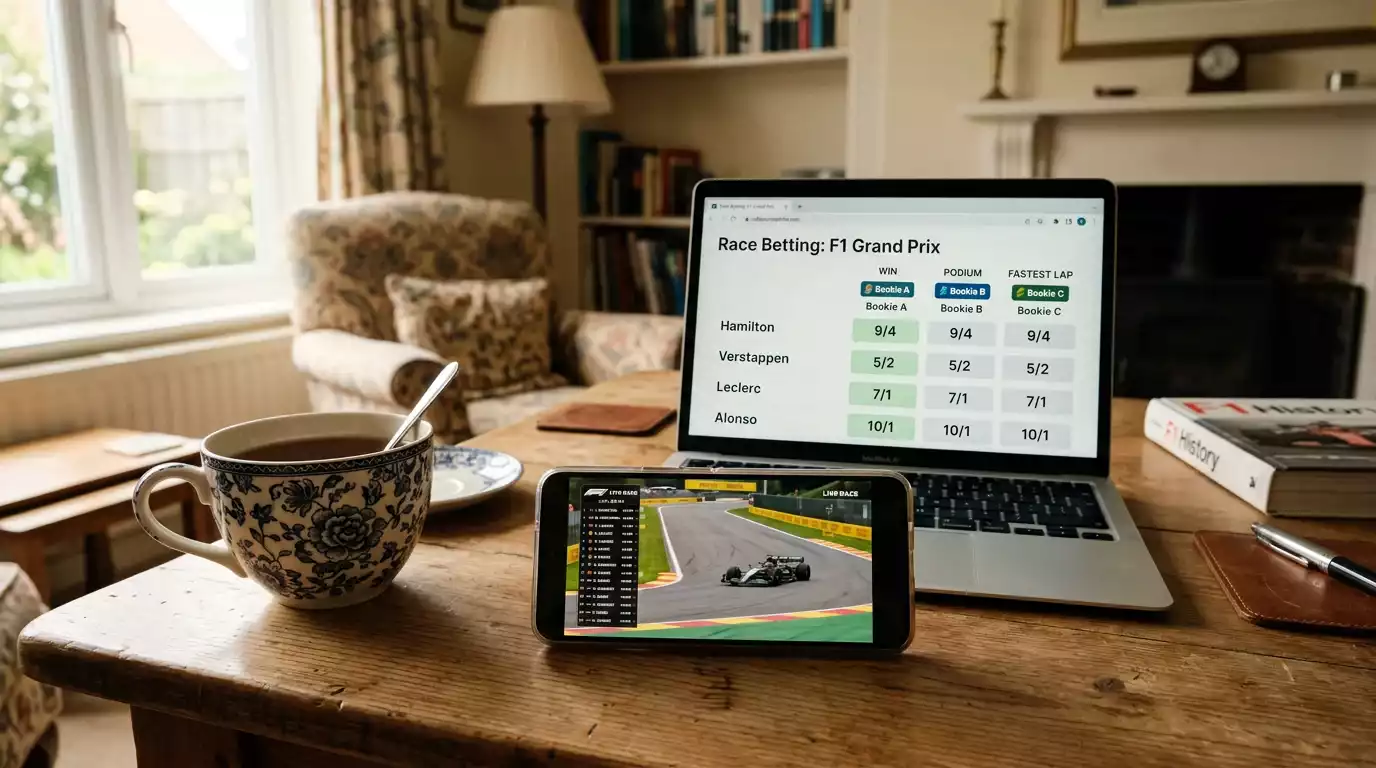
Take a practical example. A bookmaker prices a midfield driver at 14/1 for a podium finish. The exchange back price on the same driver might sit at 16.0 – a full two points higher. Over 24 races, that pricing difference on identical selections turns a break-even punter into a profitable one without changing a single piece of analysis. The Gambling Commission recorded 37.4 million active UK online gambling accounts last year, a 24% increase, yet most of those accounts still sit with traditional books where the margin eats their edge before the lights go out.
Commission rates on exchanges range from 2% to 5% on net winnings per market, depending on your volume tier and the platform. Even at 5%, the effective overround remains far below any fixed-odds book. The maths is straightforward, and that is exactly why it surprises me how many experienced F1 punters still ignore exchanges entirely.
Trading F1 Races In-Play on the Exchange
In-play trading is where exchanges stop being a cheaper bookmaker and become something fundamentally different. During the 2024 Singapore Grand Prix, I watched the race leader’s exchange price drift from 1.10 to 1.45 over three laps because he reported vibrations on team radio. Nothing had happened on track – no overtake, no pit stop, no safety car. The market moved on information, and traders who caught that drift locked in profit without caring whether he won or not.
The mechanic is called greening up. You back a driver at a high price, wait for their exchange odds to shorten, then lay at the lower price. The difference between your back and lay prices becomes your locked-in profit regardless of the race outcome. F1 is exceptionally suited to this because live betting markets react sharply to safety cars, pit-stop sequences, weather changes, and team radio snippets – all events that shift probability without ending the race.
Timing is everything. Exchange liquidity spikes at three moments during a grand prix weekend: qualifying result publication, pre-race grid formation, and the first five laps of the race. Between those windows, spreads widen and matching becomes slower. I have learned to place my opening position before qualifying and manage it during the race, rather than trying to enter fresh positions mid-race when the spreads are at their widest.
Liquidity Patterns and When to Place Your Orders
Thin liquidity kills good analysis. An exchange market with only a few hundred pounds matched at each price level means your order sits unmatched, or you accept a worse price to get filled immediately. F1 exchange liquidity follows predictable patterns that I track religiously across the season.
Major races – Monaco, Silverstone, Monza, the season finale – attract three to five times the matched volume of flyaway races in less traditional markets. The F1 Season Review 2025 recorded 6.7 million cumulative attendance across the calendar, with over 500,000 at Silverstone alone, and that fan density translates directly into exchange activity. More eyeballs mean more opinions, and more opinions mean deeper order books.
Weekday liquidity before practice sessions barely exists. Thursday evening into Friday morning sees the first real volume arrive as punters react to track walk reports and setup speculation. Saturday qualifying triggers the sharpest price movements, and by Sunday morning the race winner market holds enough depth to absorb positions of several hundred pounds without moving the price. If you need to place a large position, Sunday morning one hour before lights out is your window.
Exchange-Specific F1 Strategies That Work
My highest-percentage exchange strategy over nine seasons has been the qualifying drift trade. Before Q1, I back a driver whose practice pace looks strong at their pre-qualifying exchange price. If they nail qualifying, their price shortens and I green up for a guaranteed return. If they disappoint, I cut the loss early rather than holding through to race day. This works because qualifying results produce the most violent price movements in any F1 exchange market – far sharper than anything during the race itself, including safety car deployments.
The second strategy is what I call the retirement fade. F1 car reliability sits around 90-92% per race entry. When a driver’s exchange odds shorten to 1.05 or below during the final ten laps – effectively priced as certain to hold position – I lay small stakes. The implied probability at 1.05 is 95.2%, but the empirical retirement rate means the true probability of finishing is lower. Over a full season of 24 races, those tiny edges accumulate. Sparkco.ai’s analysis shows a 0.95 correlation between implied probability and actual bookmaker odds, and that tight correlation applies to exchange prices too, which means small inefficiencies compound reliably.
A third angle involves exploiting the gap between exchange and fixed-odds prices on the same driver. When a bookmaker offers enhanced odds on a featured race – usually the headline race each weekend – I back at the bookmaker and simultaneously lay on the exchange, locking in the price difference as arbitrage. The window for these opportunities rarely lasts longer than thirty minutes, and they require accounts at both a traditional book and an exchange, but the risk-free return on capital is consistently between 2% and 5% per qualifying opportunity.
When Exchanges Fall Short for F1 Punters
Exchanges are not a universal upgrade. During the 2023 Las Vegas Grand Prix, I tried to back an outsider at 34.0 on the exchange and managed to get only 22 pounds matched out of a 100-pound order. The remaining 78 pounds sat unmatched through the entire race. Thin liquidity on mid-grid drivers at non-traditional races is a genuine constraint that no amount of strategy can fix, you are limited by what other punters are willing to trade.
Novelty and prop markets barely exist on exchanges. Fastest lap, first retirement, number of classified finishers, these markets live almost exclusively in the fixed-odds world. If your F1 betting approach leans heavily on prop markets, exchanges will only serve as a supplement rather than a primary platform. The YouGov motorsport survey found that 31% of motorsport bettors spend over 100 pounds per month on their habit, and punters at that volume level benefit most from splitting their activity between exchange and traditional books depending on market type.
Tax treatment differs too. Exchange commission is charged on net winnings per market, not per bet, which means losing trades within the same market reduce your commission bill. This is actually an advantage for active traders but creates an accounting headache if you are tracking performance across multiple platforms.
Choosing the Right Races for Exchange Betting
Not every grand prix deserves exchange attention. I divide the calendar into three tiers based on expected liquidity and price efficiency. Tier one includes Silverstone, Monaco, Monza, Abu Dhabi, and any race with championship implications, these produce the deepest markets and the tightest spreads. Tier two covers established European races and high-profile events like Japan and Australia. Tier three is everything else, new street circuits, early-season flyaway races where the competitive order is still forming.
Tier-one races are where in-play trading works best because liquidity supports rapid position management. Tier-two races suit pre-race exchange bets where you lock in value before the formation lap and accept the result. Tier-three races push me back toward traditional bookmakers, where at least my bet gets accepted instantly rather than sitting unmatched in an order book that barely moves.
The pattern repeats every season, and tracking your own results by race tier quickly reveals where exchanges add genuine value versus where they create friction. My own records show exchange-only seasons producing a 4-6% higher return on turnover than traditional-book-only seasons, but the gap closes sharply when I include tier-three races where execution quality drops.
Building an Exchange-First F1 Betting Workflow
After nine years of splitting my F1 punting between exchanges and traditional books, the workflow that survives every regulation change and format tweak looks like this. Practice sessions feed the research. Qualifying triggers the first exchange position. Race morning refines the position based on weather, grid penalties, and tyre allocation data. In-play management happens during the race, with green-up targets set before lights out.
The discipline is in the green-up targets. Without them, I hold positions too long, watch profits evaporate on a late safety car, and end up worse than if I had just placed a traditional bet and walked away. Setting a target price to green up before the race starts removes emotion from the equation entirely. GrandPrix247’s team valuation data pegs the average F1 team at 3.42 billion dollars in 2025, and with that kind of institutional investment driving performance consistency, the exchange prices increasingly reflect deep analytical consensus rather than casual punter sentiment.
Start with race winner markets, get comfortable with back-and-lay mechanics, and add in-play trading only after you can green up without second-guessing yourself. The exchange rewards patience and punishes impulsiveness, which is the opposite of what most traditional betting environments train you to do. See also: build custom multiples with the F1 bet builder feature guide.
What is the main advantage of using a betting exchange for F1?
The primary advantage is better odds. Exchange markets operate with overrounds of 101-103%, compared to 115-130% at traditional bookmakers. This means higher prices on every selection, which compounds into significantly better returns over a full F1 season.
Can I trade F1 races in-play on a betting exchange?
Yes. Exchanges allow in-play trading where you can back a driver before the race and lay at a shorter price during the race to lock in profit regardless of outcome. F1 is well-suited to this because safety cars, pit stops, and weather changes create frequent price movements.
Do betting exchanges have good liquidity for F1 markets?
Liquidity varies by race and market type. Major races like Silverstone, Monaco, and Monza attract deep order books, while less established events produce thinner markets. Race winner markets carry the best liquidity, while prop bets and novelty markets are largely absent from exchanges.
Written by the editors at f1 Betting Guide.