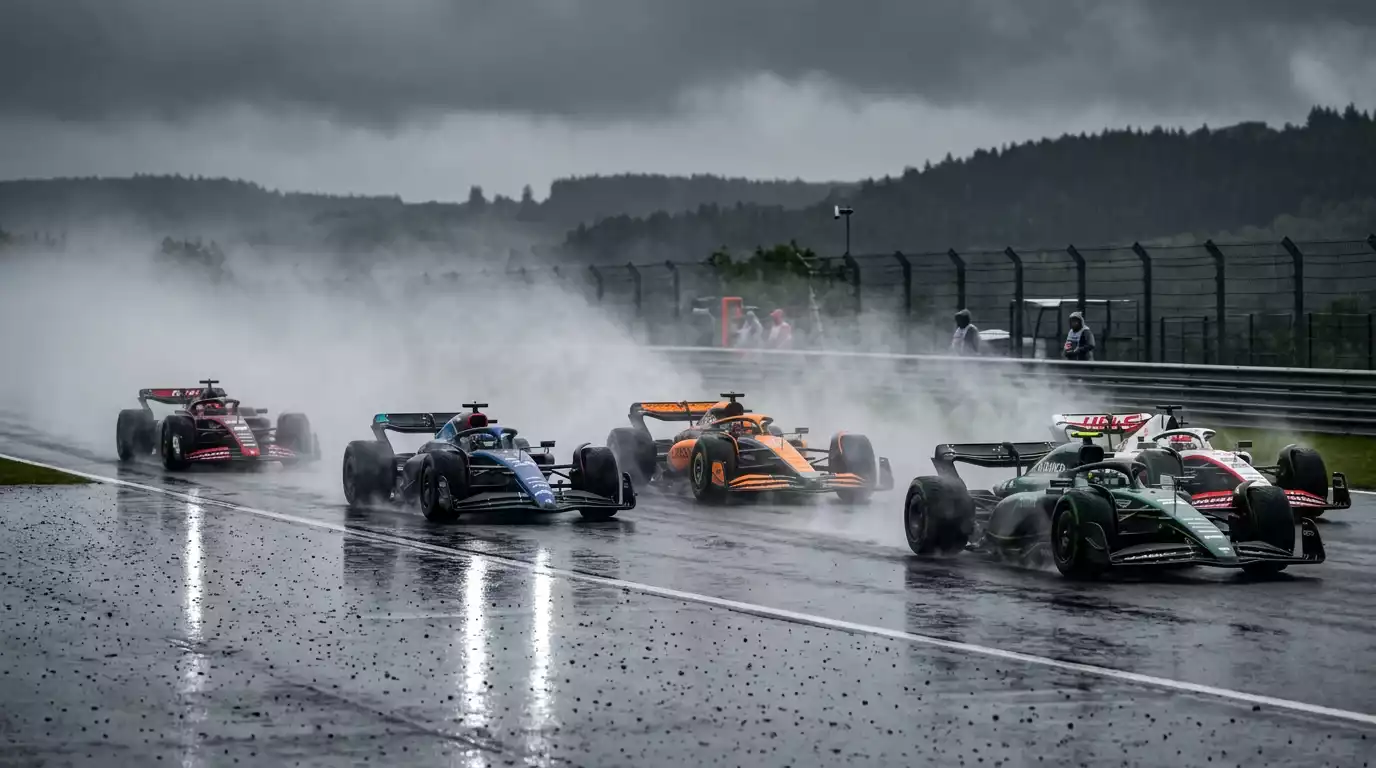
F1 2026 Regulations and Betting: How New Rules Reset the Odds
 Available in US

Regulation changes are the great equaliser in Formula 1. Every few years, the sport rewrites its technical rulebook, and the established order – teams that dominated under the old rules – suddenly finds itself scrambling to understand a completely different set of engineering constraints. For bettors, these resets are gold. The certainty that bookmakers rely on to price championship markets evaporates, volatility spikes, and the gap between what the odds say and what actually happens on track widens dramatically. The 2026 regulations represent the most radical reset in over a decade, and the betting implications are enormous. See also: f1 betting guide for championship and outright markets.
Key Technical Changes in the 2026 Regulations
George Russell put it plainly: fans are “loving the racing at the moment” – but the cars they are loving will be fundamentally different machines in 2026. The new power units generate roughly 50% of their output from electric motors, up from approximately 30% under the current regulations. That is not a minor tweak. It reshapes which manufacturers have the best technology, which teams have invested their development budget wisely, and which driver skillsets translate to the new formula.
The cars themselves are lighter and smaller. The minimum weight drops, the aerodynamic philosophy shifts toward active aerodynamics – moveable bodywork that adjusts during a lap – and the overall downforce levels are designed to allow closer racing. In theory. In practice, no one knows how these changes will play out until the first car hits the track in pre-season testing, and even then the competitive picture takes several races to stabilise.
For bettors, three specific changes matter most. First, the power unit shift rewards manufacturers who have invested in electric motor and battery technology – Honda, Mercedes and Ferrari have all taken different development paths, and the performance gap between them will likely be wider than under the current stable regulations. Second, the lighter cars change tyre degradation profiles, which rewrites pit stop strategy for every circuit. Third, the active aerodynamics introduce a variable that did not exist before: teams can gain or lose performance depending on how well their aero system adapts to different track types.
Why Regulation Changes Reset the Competitive Order
The average F1 team is now valued at 3.42 billion dollars, per GrandPrix247 data from 2025 – more than double the 2023 figure. Those valuations are built on the assumption that competitive position is reasonably stable under consistent regulations. When the rules change, that assumption collapses. A team that spent three years perfecting the ground-effect aerodynamics of the current formula starts from near-zero on the active aero concept. Budget does not guarantee success – it guarantees the resources to iterate, but the initial concept has to be right.
History supports this. The 2014 hybrid regulations saw Mercedes leap from midfield to dominant, while Red Bull, the team of the preceding era, struggled for two seasons. The 2009 regulation change produced a championship challenge from Brawn GP, a team that entered the season on the verge of financial collapse. The 2022 ground-effect regulations reshuffled the midfield entirely, with teams like Alfa Romeo and Alpine temporarily jumping ahead of more established operations.
The pattern is consistent: the first season under new regulations produces a wider spread of performance than any subsequent season. That spread is the bettor’s friend. When the field is compressed, short-priced favourites win most races and value is scarce. When the field is spread unpredictably, longer-odds selections hit more frequently, each-way bets pay more often, and the market’s reliance on prior-season form becomes a liability rather than an asset.
Higher Volatility, Better Odds?
Futures-market turnover on F1 drivers reached an estimated 45 million dollars in 2024, per Sparkco.ai data, and that figure was generated under regulations where the competitive order was well understood. Under new regulations, the volume may increase as interest peaks around the novelty of a reset, but the quality of the odds, from a bettor’s perspective, improves because the bookmaker’s pricing models lose their primary input: recent performance data.
Bookmakers price early-season markets using a blend of prior-season results, pre-season testing impressions and engineering analysis. Under stable regulations, that blend produces accurate prices. Under new regulations, prior-season results are near-worthless as a predictor. Testing impressions are unreliable because teams run different fuel loads, engine modes and development parts. Engineering analysis is publicly available only at a surface level. The result: odds that are educated guesses rather than calibrated probabilities.
For the prepared bettor, this creates a window. If you have followed pre-season testing closely, analysed the technical regulations in detail, and formed your own assessment of which teams and manufacturers have made the right conceptual choices, your probability estimates may be meaningfully more accurate than the market’s. That gap closes quickly, by round five or six, real race data begins to dominate, and the market corrects itself. But the first four or five races of a new regulation era offer the widest and most exploitable pricing inefficiencies in F1 betting.
Which Markets Are Most Affected
Championship outrights are the most volatile market under new regulations. The pre-season favourite for the drivers’ championship often drifts significantly after the first few races, as real-world performance either confirms or contradicts expectations. Backing a driver at pre-season prices and then watching those odds shorten after strong early results is the classic play, but it requires conviction that your pre-season assessment is sharper than the market’s.
Constructor championship markets are arguably even more affected, because the regulation reset changes the relative performance of entire teams rather than individual drivers. A manufacturer that nails the new power unit gives both its drivers a platform, which makes constructor markets a more direct expression of the regulation impact than driver markets.
Race-winner and podium markets during the opening rounds carry unusual value because the field spread is unknown. A driver priced at 20/1 who might genuinely be in a car competitive enough for a podium represents a different proposition in the first round of new regulations than in the fifteenth round of stable ones. The data-driven approach to F1 betting strategy covers how to adjust your pre-race analysis framework when historical data becomes less reliable.
Each-way betting comes into its own during regulation transitions. The wider performance spread means more drivers have a realistic shot at a podium finish, which inflates the place component of each-way bets. If you typically bet each-way at 14/1 and above, the early rounds of a new regulation cycle may offer value at even shorter prices, because the true probability of a podium finish for midfield drivers is temporarily higher than the market acknowledges. See also: explore unique angles with F1 night race betting tips.
Which specific technical changes in 2026 have the biggest impact on odds?
The shift to 50% electric power output is the single largest variable, because it determines which manufacturer gains or loses relative performance. Active aerodynamics and reduced car weight also matter, as they change how cars perform at different circuit types. Bookmakers struggle to price these changes accurately before real race data is available, which creates value opportunities in the opening rounds.
Should I wait until the season starts before placing 2026 outright bets?
Pre-season outright bets carry higher risk but also offer potentially larger value gaps, because the market is pricing without real performance data. Waiting until after round two or three gives you actual race data but typically tighter odds on the emerging favourites. A balanced approach is to place a small portion of your outright budget pre-season and reserve the rest for early-season adjustments once genuine performance hierarchies emerge.
Created by the ”f1 Betting Guide” editorial team.