F1 Betting Odds Explained: Formats, Implied Probability and Line Movement
 Available in US
Table of Contents
- Fractional Odds: The UK Standard
- Decimal Odds: The European Format
- American Odds: Moneyline Explained
- Calculating Implied Probability From Any Format
- Understanding Bookmaker Overround and Margin
- Why F1 Odds Move: Triggers and Timing
- Reading Championship Outright Odds
- Comparing Odds Across Bookmakers
- Common Questions About F1 Odds
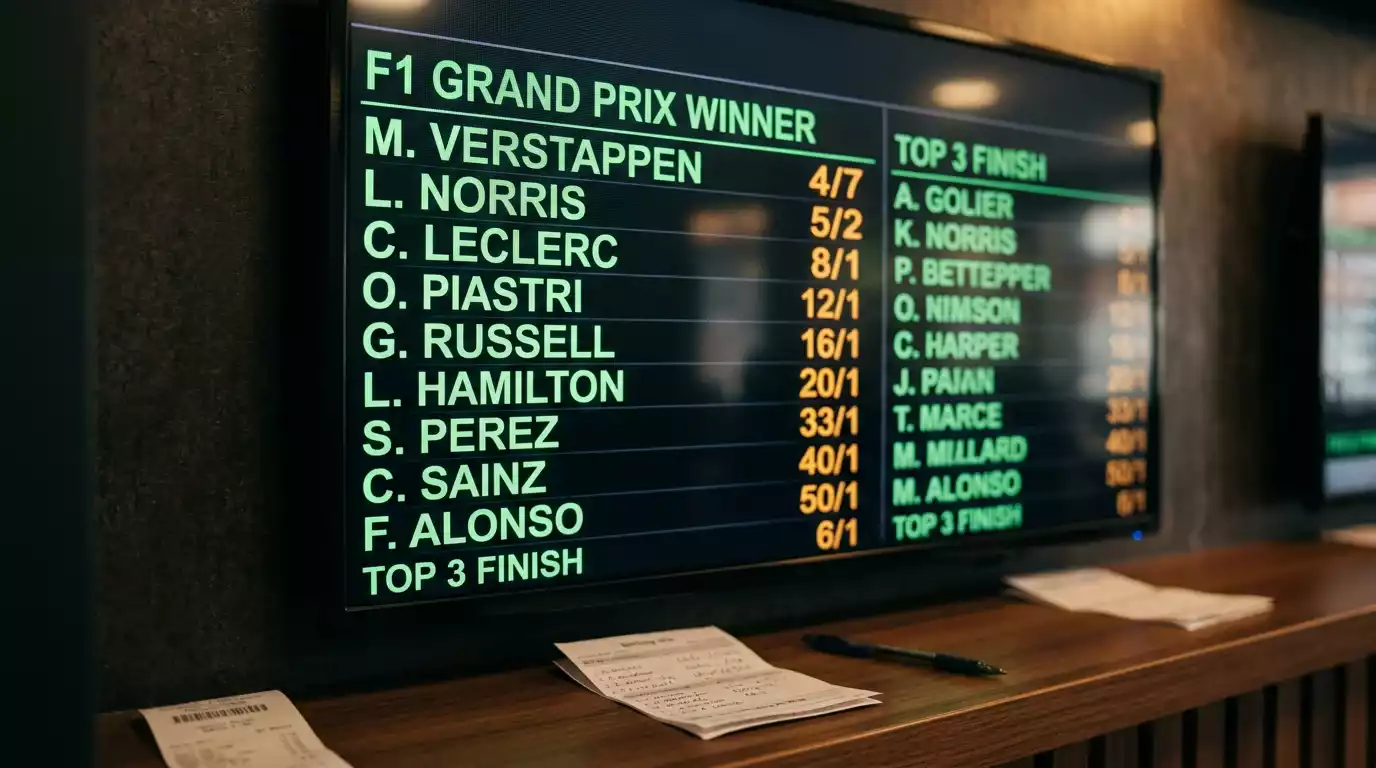
The first time I looked at F1 championship odds, I saw a number – 7/2 – and thought it meant seven cars for every two drivers, or something equally absurd. That confusion lasted about thirty seconds, but it planted a seed: if I did not understand what the numbers meant, I could not possibly know whether a bet was worth taking. See also: f1 betting guide for our complete odds and analysis hub.
F1 betting odds are the language of probability. Every price a bookmaker publishes is a statement about how likely they think an outcome is, adjusted by a margin that guarantees them a profit over time. Understanding that language, across fractional, decimal, and American formats, is not optional if you want to bet with any kind of edge. Over the last two seasons, F1 has shown a 0.95 correlation between market-implied probabilities and actual bookmaker coefficients, according to Sparkco’s analysis. That means the market is broadly efficient, but “broadly” leaves room for the punter who can read the odds more carefully than the next person.
This guide takes you through every odds format you will encounter, teaches you to calculate implied probability from any of them, and explains how and why F1 odds move. By the end, you will read a betting slip the way an analyst reads a spreadsheet – as raw data waiting to be interpreted.
Fractional Odds: The UK Standard
Walk into any high-street bookmaker in Britain and you will see odds written as fractions: 5/1, 11/4, 1/3. I still think in fractional odds instinctively, and so do most UK punters. The format tells you exactly what you will win relative to your stake.
The number on the left is your potential profit. The number on the right is your stake. At 5/1, every pound you wager returns five pounds of profit plus your original stake for a total of six pounds. At 11/4, a four-pound bet yields eleven pounds of profit plus your four back, for fifteen pounds total. At 1/3, you need to stake three pounds to win one pound of profit, receiving four pounds back.
Fractional odds divide neatly into three categories that matter for F1 betting. “Odds against” means the left number is bigger than the right: 3/1, 7/2, 9/4. These represent outcomes the bookmaker considers unlikely, such as a midfield driver winning a race. “Odds on” means the right number is bigger: 1/2, 4/9, 2/7. These represent heavy favourites: the dominant championship leader at a power circuit where their car excels. “Even money,” written as 1/1 or Evs, means the bookmaker sees the outcome as a coin flip.
For F1 outrights (championship winner bets placed before or during the season) fractional odds can look intimidating. A driver might be priced at 33/1 or even 100/1. Those numbers are not meant to scare you; they are an honest reflection of how improbable the outcome is. A 100/1 shot is expected to win roughly once in every 101 attempts. In a 20-driver F1 field with significant car performance gaps, most drivers genuinely are that unlikely to win the title.
The practical skill with fractional odds is quick mental conversion. The fastest method: divide the left number by the right number. That gives you the profit per pound. At 7/2, the profit per pound is 3.5. Stake ten pounds, profit thirty-five. At 11/8, profit per pound is 1.375. Stake eight pounds, profit eleven. Once this calculation becomes automatic, you can scan a list of F1 prices and instantly gauge which end of the probability spectrum each selection sits on.
One quirk of fractional odds that trips up beginners: they do not include your stake in the return. When a bookmaker says “5/1,” your total return is six times your stake, not five. This seems obvious once you know it, but I have seen plenty of bettors miscalculate their potential payout because they forgot to add the stake back.
Decimal Odds: The European Format
Decimal odds are the standard across continental Europe, and they have one major advantage over fractional: the number you see is your total return per unit staked, including the stake itself. No mental arithmetic needed to work out what you actually get back.
A driver priced at 6.00 in decimal odds returns six pounds for every pound wagered. That is equivalent to 5/1 fractional. A driver at 1.33 returns one pound thirty-three pence per pound staked, equivalent to 1/3 fractional. The conversion formula is simple: decimal odds = (fractional numerator / fractional denominator) + 1.
I switched to decimal odds for my own record-keeping about five years ago, and it made everything cleaner. Comparing prices across bookmakers is faster because you are just comparing single numbers. A driver at 4.50 at one bookmaker versus 4.20 at another: the better price is immediately obvious. With fractional odds, you would need to compare 7/2 against 16/5, which requires conversion before you can spot the difference.
Decimal odds also make expected value calculations more straightforward, which matters when you are building any kind of systematic betting approach. Multiply your estimated probability of an outcome by the decimal odds, and if the result is greater than 1.00, you have a positive expected value bet. At decimal odds of 4.50, you need to believe the outcome has at least a 22.2% chance of occurring for the bet to be theoretically profitable. If your model says the probability is 28%, you have edge.
Most UK betting sites now let you toggle between fractional and decimal display. For race-day betting, use whichever format you think fastest in. For analysis and record-keeping, decimal is objectively more practical. I keep all my spreadsheets in decimal and only convert to fractional when I am writing about odds for a UK audience, which is precisely what I am doing now.
American Odds: Moneyline Explained
American odds, also called moneyline, use a plus or minus sign to indicate underdogs and favourites. You will encounter them mainly on US-facing platforms, but as F1 grows its American audience (the US fanbase hit 52 million in 2025), more UK punters are seeing these numbers on international exchanges and social media discussions.
Positive numbers show profit on a $100 stake. A driver at +350 returns $350 profit on a $100 bet. Negative numbers show how much you need to stake to win $100 profit. A favourite at -200 requires a $200 bet to earn $100. Converting to the formats you already know: +350 equals 7/2 fractional or 4.50 decimal. -200 equals 1/2 fractional or 1.50 decimal.
The conversion formulas, if you need them: for positive American odds, divide by 100 and add 1 to get decimal, or express as the American number over 100 to get fractional. For negative odds, divide 100 by the absolute value and add 1 for decimal. In practice, I rarely convert manually. Most platforms do it automatically. But understanding the logic helps when you see prices quoted in American format on US-centric F1 betting discussions.
Calculating Implied Probability From Any Format
Here is where odds stop being abstract numbers and start being tools. Every set of odds implies a probability: the bookmaker’s estimate of how likely an outcome is, before their margin is applied. Learning to extract that implied probability is the single most important analytical skill in betting.
The formula is straightforward. For fractional odds of A/B: implied probability = B / (A + B). At 5/1, that is 1 / (5 + 1) = 16.7%. At 11/4, it is 4 / (11 + 4) = 26.7%. For decimal odds, it is even simpler: implied probability = 1 / decimal odds. At 6.00, that is 1 / 6 = 16.7%. At 3.75, it is 1 / 3.75 = 26.7%.
Now, here is the part that changes how you think about betting. Once you can extract implied probability from odds, you can compare the bookmaker’s assessment against your own. Suppose a driver is priced at 4.00 (3/1 fractional), implying a 25% probability of winning. If your analysis (qualifying data, track history, weather conditions, tyre strategy) suggests that driver actually has a 33% chance, you have found a positive expected value bet. The bookmaker thinks it is a one-in-four shot; you think it is one-in-three. Over many such bets, that gap is where profit accumulates.
Sparkco’s analysis of the last two F1 seasons found a 0.95 correlation between market-implied probabilities and actual outcomes. That is high, but not 1.00. The 5% gap represents pricing errors, slow adjustments to new information, and markets where bookmakers lack deep expertise. F1, with its 0.4% share of global betting volume, gets far less pricing attention than football or horse racing, which is exactly why implied probability analysis works better here than in more mature betting markets.
A practical exercise: before every race, pull up the race winner odds for the top six drivers. Convert each to implied probability. Sum them. If the total is, say, 85%, the remaining 15% is spread across the rest of the field. Compare that 15% against your own assessment of whether an outsider has a realistic chance. At circuits known for disruption – wet races, street circuits, regulation-change seasons – that tail probability is often underpriced.
Implied probability is the bridge between reading odds and placing smart bets. Everything else in this guide (overround, line movement, odds comparison) builds on this foundation.
Understanding Bookmaker Overround and Margin
A fair market would price all outcomes so their implied probabilities sum to exactly 100%. Bookmakers do not run fair markets. They add a margin, called the overround, that guarantees them a profit regardless of the outcome.
To calculate overround, convert every selection’s odds to implied probability and add them up. In a race winner market with 20 drivers, you might get a total of 118%. That extra 18% is the overround – the bookmaker’s built-in edge. The higher the overround, the worse the odds are for you as a punter.
F1 markets tend to carry higher overround than football because there are more possible outcomes. A football match has three results: home, draw, away. A typical overround is 5-8%. An F1 race has 20 possible winners, and the overround often runs between 15% and 25%. Championship outright markets, with 20 drivers priced across a season, can push even higher.
The overround is not distributed evenly across all selections. Bookmakers typically load more margin onto the favourites and less onto the longshots. This means that backing a heavy favourite in F1 is almost always poor value relative to backing a longer-priced selection. At 1/5 (implied probability 83%), the bookmaker might have priced the true probability at 78% and added five percentage points of margin. At 25/1 (implied probability 3.8%), the margin loaded might be only 0.5%. The longshot is closer to “fair” odds.
UK remote betting generated GGY of £2.6 billion in the year to March 2025, per the Gambling Commission. That revenue comes directly from overround and other structural edges built into the product. Understanding overround will not eliminate the bookmaker’s advantage, but it tells you where that advantage is weakest – and that is where you should be placing your bets.
One practical habit: compare the overround across different bookmakers for the same F1 market. If one bookmaker runs a race winner market at 120% and another at 115%, the second is offering better overall value. Over a season of betting, those few percentage points compound significantly.
Why F1 Odds Move: Triggers and Timing
I once watched a driver’s race winner odds collapse from 8/1 to 3/1 in the space of forty minutes on a Saturday afternoon. The trigger was obvious in hindsight – qualifying had just finished, and that driver had taken pole position on a street circuit where grid position is decisive. But at the time, the speed of the move caught me off guard. F1 odds do not drift gently; they lurch.
The primary triggers for F1 line movement are qualifying results, weather forecasts, and breaking news about mechanical issues or penalties. Qualifying is the biggest single mover. In Formula 1, grid position correlates strongly with race outcome, far more so than in most other motorsports. When qualifying reshuffles expectations, bookmakers reprice the entire race winner market within minutes.
Weather is the second major trigger. If a dry race is expected and rain arrives, the favourite’s odds lengthen and the field compresses. Historically strong wet-weather drivers see their prices shorten dramatically. This is one area where acting fast gives you a genuine advantage – if you spot a weather change before the bookmaker adjusts, you can lock in odds that reflect a reality that no longer exists.
Betting volume on F1 driver futures rose from $36 million in 2023 to an estimated $45 million in 2024, per Sparkco. That growing liquidity means odds are adjusting faster and more accurately than they did even three years ago. But F1 is still a relatively thin market compared to football, which means significant individual bets can move the line. If you see a sharp, sudden movement without an obvious news trigger, it often signals a large informed wager – “sharp money” in betting parlance.
Jonny Haworth, F1’s commercial partnerships director, has spoken about working to develop a more engaging betting product that goes beyond simple outcome betting and uses real-time race data. As these new products come online, expect even more dynamic odds movement during races themselves, where in-play prices will react to pit stops, tyre degradation, and positional battles in real time.
My approach to line movement is simple: have your analysis ready before the prices start moving. If I believe a driver is overpriced at 6/1 on Thursday, I place the bet then – not on Saturday afternoon after qualifying confirms what I already suspected, by which point the price has halved. The best odds are available to the punter who has done their homework earliest.
Reading Championship Outright Odds
Championship outright odds behave differently from race-day prices because they span an entire season. A driver’s championship odds at Round 1 reflect a blend of car performance expectations, driver ability, historical precedent, and public perception. By Round 10, they reflect actual results – and the transition between those two pricing regimes is where the most interesting value opportunities live.
Early-season championship odds tend to overweight the previous year’s standings. If a driver won the title in 2025, they will be priced as favourite going into 2026, even if the regulation changes have reshuffled car competitiveness. This anchoring bias creates value on drivers whose teams have made significant off-season gains but whose prices have not yet adjusted.
Mid-season championship odds are more efficient because they are based on actual race results. But they can overcorrect to recent performance. A driver who wins three of the first five races will see their championship price shorten dramatically, sometimes to 1/3 or shorter. If you believe the early dominance will not sustain – perhaps the team benefited from a development advantage that other teams will close – laying that driver on an exchange or backing a rival at inflated odds can be a strong play.
The end-of-season dynamics are different again. Once the championship is effectively decided – when the points gap is mathematically insurmountable – the market closes. But in seasons where the title fight goes deep, the final few races see enormous odds swings. A single retirement can take a driver from 1/4 to even money in a championship market. Those moments reward the punter who has a clear framework for how much each race result should shift the probabilities.
Comparing Odds Across Bookmakers
Odds comparison is the closest thing to free money in betting. The same driver, the same race, the same market – and two bookmakers offer meaningfully different prices. One has the driver at 7/2, the other at 4/1. That gap is not unusual in F1, especially in the smaller markets where bookmakers price independently rather than following a consensus.
Among motorsport bettors, usage of major UK platforms varies widely. YouGov data from 2025 shows that 41% of motorsport bettors used Bet365 in the preceding week, with DraftKings and FanDuel at 32% and 30% respectively – though those US-centric platforms serve a different market. The point is that punters cluster around a small number of operators, and the operators they are not using may be offering better prices.
I maintain accounts with four UK-licensed bookmakers specifically for F1 betting. Before placing any race-day bet, I check all four. The process takes under two minutes and has saved me – or rather, earned me – thousands of pounds over nine seasons. A 10% better price on a winning bet at 4/1 versus 7/2 is the difference between a forty-pound return and a thirty-five-pound return on a ten-pound stake. Across hundreds of bets per season, those margins are the margin between a profitable year and a breakeven one.
Aggregator sites automate this comparison, and they are useful for a quick scan. But they sometimes lag behind the latest price movements by a few minutes, which matters during the fast-moving qualifying-to-race window. For time-sensitive bets, I check the bookmaker apps directly.
Line shopping is not glamorous, and it does not require any sophisticated analytical skill. But it is the single most effective habit a bettor can develop. If value betting is about finding the right selections, odds comparison is about ensuring you get the best possible price on those selections. Both matter equally. See also: check out our F1 rookie betting guide for fresh market opportunities.
Common Questions About F1 Odds
Why do different bookmakers offer different F1 odds?
Each bookmaker sets prices based on their own risk models, customer betting patterns, and competitive positioning. F1 is a smaller market than football or horse racing, so bookmakers have less data to work with and less incentive to match competitors precisely. This means prices on the same selection can vary by 10-15% across operators – a significant gap that disciplined odds comparison can exploit.
What does overround mean and how does it affect my F1 bets?
Overround is the bookmaker’s built-in margin. If you convert every selection’s odds to implied probability and add them together, the total will exceed 100%. The excess – typically 15-25% in F1 race winner markets – is the overround. It means the odds you receive are slightly worse than the true probability of each outcome. The higher the overround, the harder it is to find value. Comparing overround across bookmakers helps you identify who offers the fairest overall pricing.
How quickly do F1 odds change before a race?
The biggest movements happen during and immediately after qualifying on Saturday, when grid positions are finalised. A driver who takes an unexpected pole position can see their race winner odds halve within minutes. Weather forecast changes also trigger sharp moves. Between Thursday market opening and Sunday race start, odds can shift by 50% or more for individual drivers. The best prices are generally available early in the week before qualifying reshuffles expectations.
Written by the editors at f1 Betting Guide.